This divergence reveals a widening gap between projects that maintain stable demand after listing and those whose value plummets shortly after listing. CryptoRank measures the change in value of each token after full dilution since its creation event.

Join the official OpenScore community :
Telegram: @openscoreapp
WhatsApp: wa.me/971586321066
Line: line.me/ti/p/_GPRgudDF4
Genius Token topped the list of airdrop gains in the second quarter, with its valuation soaring by 120%.
All four projects saw their stock prices rise. Among them, Genius, the non-custodial trading platform under Shuttle Labs, saw the largest increase, rising 120% from its IPO valuation of $170 million.
o1.exchange (O), launched last week, followed closely with a 77.9% stake, followed by Billions Network (BILL) with a 73% stake, and Re Protocol (RE) with a 64.5% stake.
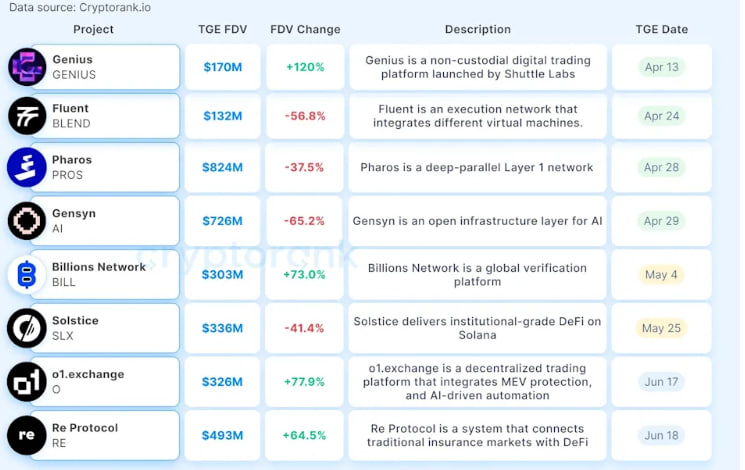
Meanwhile, stocks that declined saw even larger drops. Gensyn, an open infrastructure platform for artificial intelligence (AI), saw its market capitalization plummet 65.2% from $726 million. Fluent (BLEND) fell 56.8%, while Solstice (SLX) and Pharos (PROS) dropped 41.4% and 37.5%, respectively.
It's worth noting that some ultimately unsuccessful companies had valuations far exceeding those of successful ones at the time of their IPOs. Pharos and Gensyn both had first-day valuations exceeding $700 million, meaning they still have significant downside potential. The airdrop model itself is also under scrutiny, and this outcome is mixed. Delphi Digital recently pointed out that this strategy is outdated because airdrops now cultivate sellers rather than loyal token holders.
The study tracked 3.7 million wallets across six major cryptocurrencies over a five-year period. The results showed that 78% to 94% of the receiving wallets sold off their entire allocation within 90 days.
The second quarter data further confirms this argument. With only half of the participants holding value assets, the next few quarters may reveal whether performance-linked models will replace traditional giveaway models.